Blog post
How to Automatically Flag Non-Standard Contract Clauses Before Signing
A practical guide to detecting changed, missing, and one-sided contract terms before they become signed obligations.
The dangerous edit is rarely the one that looks dramatic
A client sends over its standard services agreement on Friday afternoon. The fee is correct, the project description looks familiar, and the document is only twelve pages. Nothing appears hostile. You are told that the template is routine and that everyone signs it.
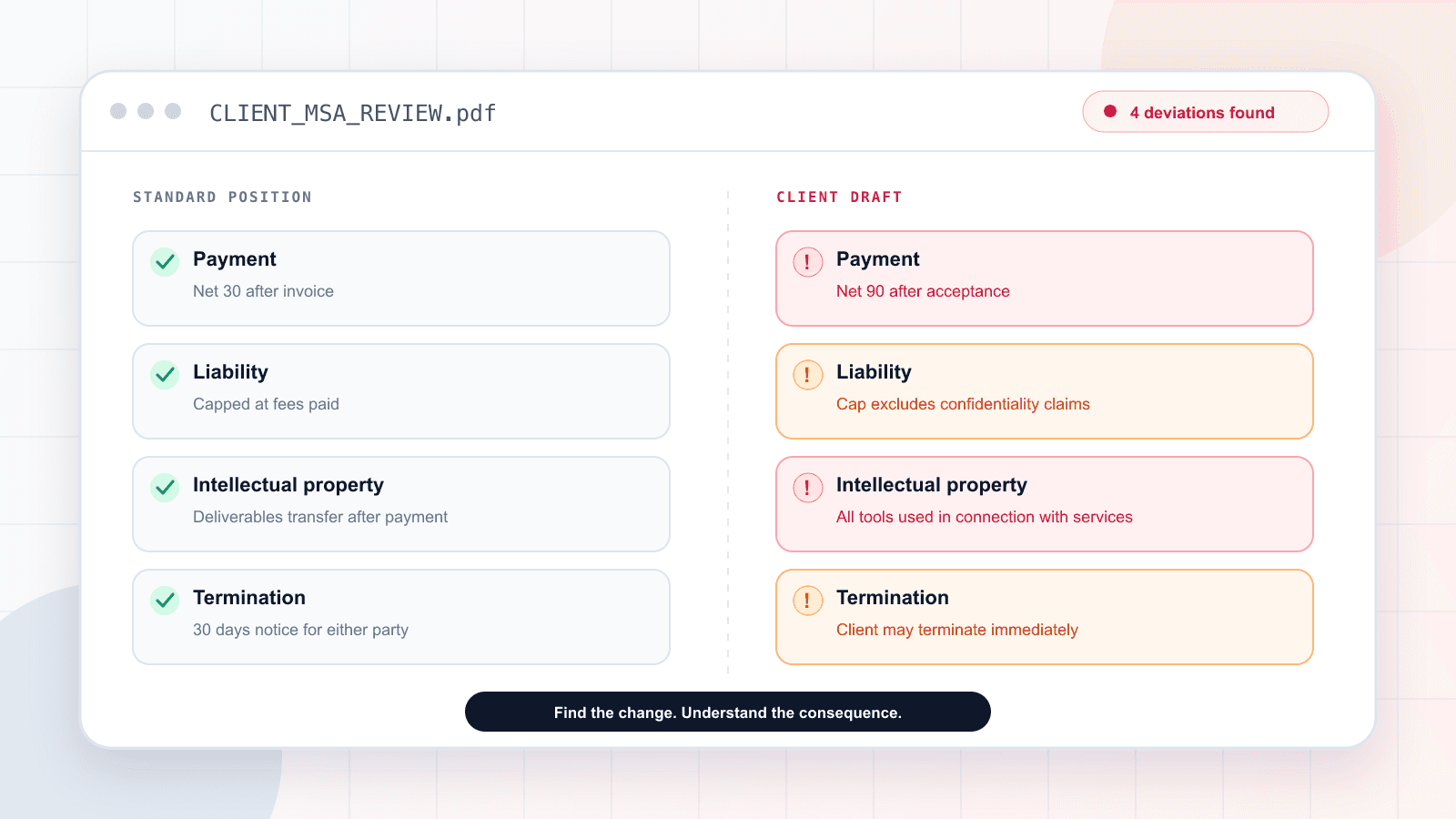
Three edits are easy to miss. Payment has moved from 30 to 90 days after acceptance. The liability cap no longer applies to confidentiality claims. Ownership now covers every tool used while delivering the project, not just the final deliverables. None of those changes arrives under a heading called Risk. They sit inside ordinary clauses, surrounded by language you have seen before.
That is the real value of automatically flagging non-standard contract clauses. The goal is not to label an entire agreement good or bad. It is to find where the document departs from a reasonable baseline, explain why the departure matters to your side, and give you enough evidence to decide whether to accept, negotiate, or escalate it.
What does non-standard actually mean?
Non-standard is a comparison, not a legal conclusion. A clause can be common in one industry and unusual in another. It can match the counterparty's template while departing sharply from your own preferred position. It can also be commercially acceptable even though it is not your default.
In mature contract operations, a standard is usually recorded in a template, clause library, negotiation playbook, or approval policy. Oracle's documentation describes contract deviations as missing text, modified standard clauses, expired clauses, or other variances from established terms. The point of reporting those deviations is to give reviewers and approvers visibility into what changed before the agreement is approved.
Independent professionals and small teams rarely have a formal clause library. Their baseline is often simpler: payment within a known period, ownership limited to paid deliverables, liability proportionate to fees, a workable termination route, and no restrictions that quietly interfere with future work. An automated first pass can test for those patterns, but it should never pretend that a general baseline is the same as your company's approved legal position.
- Different from your preferred wording, but potentially acceptable.
- Outside an approved range, such as a payment term longer than 45 days.
- Missing entirely, such as a liability cap or acceptance process.
- Internally inconsistent with another definition, schedule, or exception.
- One-sided because the obligation or remedy applies to only one party.
Three kinds of automated contract review
Software vendors often use the same language for different capabilities. Before relying on a result, identify what the system is actually comparing.
A risk-pattern review reads one agreement and looks for broad language, missing protections, unusual obligations, and commercial imbalance. This is useful when you do not have a reference document. A playbook review compares the agreement with your approved positions, including fallback language and approval thresholds. A version comparison shows what changed between two drafts, but it does not necessarily explain the commercial effect of the change.
The strongest workflow combines all three. Version comparison answers what changed. A playbook answers whether the change is allowed. Contextual analysis answers what the clause may mean for the person signing. If a product offers only one of these, its report should say so clearly.
- Risk-pattern review: useful for a first pass against common protections and risk categories.
- Playbook comparison: useful for enforcing company-specific preferred and fallback positions.
- Version comparison: useful for identifying additions, deletions, and wording changes between drafts.
The eight deviations worth checking first
Not every change deserves the same attention. Renumbered sections and stylistic edits may be harmless. A single deleted exception can matter more than two pages of new boilerplate. Start with the terms that affect cash, ownership, downside, and your ability to leave.
- Payment and acceptance: longer payment periods, subjective acceptance, pay-when-paid language, broad withholding rights, or no deadline for raising defects.
- Scope and change control: undefined deliverables, unlimited revisions, dependencies assigned only to you, or additional work that requires no written approval.
- Liability: a missing aggregate cap, a cap based on an amount lower than expected, or exceptions broad enough to make the cap meaningless.
- Indemnity: responsibility for claims outside your control, a duty to defend before fault is established, or obligations that are not reciprocal.
- Intellectual property: transfer before payment, ownership of pre-existing tools, restrictions on general know-how, or no license back for reusable components.
- Termination: immediate termination for the other party, no cure period for you, no payment for completed work, or survival language that keeps too many duties alive.
- Renewal and notice: automatic renewal, short cancellation windows, notice methods that are easy to miss, or price changes tied to renewal.
- Disputes and governing law: a distant venue, mandatory arbitration with disproportionate cost, one-sided fee shifting, or a jurisdiction that does not match the commercial setup.
Why keyword matching produces weak results
A search for the word liability will find a heading. It will not tell you whether the cap applies to indemnity, whether a later schedule overrides it, or whether the definition of Losses includes indirect damages. Contract meaning is distributed across sentences, definitions, exceptions, and cross-references.
The same phrase can also carry different consequences depending on who you are. A broad license may be necessary for a customer using commissioned software, but excessive when it reaches the contractor's pre-existing libraries. A 60-day payment term may be manageable for a large supplier and damaging for a solo consultant funding the work personally.
Useful automated review therefore needs context: agreement type, your side, contract language, governing jurisdiction, and the commercial purpose of the deal. It should identify both what is present and what is absent. Most importantly, it should show the source clause so a human can verify the finding instead of accepting an unsupported summary.
A practical example: one sentence, three consequences
Consider this sentence: Contractor assigns to Client all right, title, and interest in any materials, methods, concepts, tools, or developments used in connection with the Services.
At first glance, it looks like a conventional ownership clause. The phrase used in connection with the Services changes the picture. It may reach background tools created before the project, methods used for other clients, and general components that were never priced as a sale. If the assignment takes effect immediately, the client may also receive ownership before paying the invoice.
A useful report would separate the issues. First, the ownership scope extends beyond project-specific deliverables. Second, there is no carve-out for pre-existing materials. Third, there is no condition tying transfer to full payment. The negotiation response can then be precise: define Deliverables, retain ownership of background materials, grant the client the license it actually needs, and make transfer of commissioned deliverables effective after payment.
That is more valuable than calling the clause high risk. A label creates alarm. A clause-level explanation creates a decision.
What a trustworthy deviation report should contain
A long list of warnings is not evidence of a thorough review. It can be evidence that the system has no way to prioritize. A useful report makes the review smaller, not noisier.
For each important finding, expect a plain title, severity, exact contract evidence, the practical consequence, and a focused next step. If the system compares against a playbook, it should also identify the preferred position, acceptable fallback, and approval rule that produced the flag. If no reliable source text can be matched, the report should disclose that limitation.
- Exact quoted language and a page or section reference where available.
- The baseline or rule used to classify the deviation.
- An explanation written for the person making the commercial decision.
- A suggested question or narrow revision rather than a complete rewrite by default.
- A clear distinction between detected text, model interpretation, and jurisdiction-specific legal advice.
- Positive terms that should be preserved during negotiation, not only negative findings.
How to review a flagged clause without creating a new problem
Do not negotiate every deviation simply because software found it. Some changes reflect the actual deal. Others are low-impact drafting preferences. Start with the consequence: what can happen, how likely is it, how large could the loss be, and can you control the event that triggers it?
Next, read the clause with its definitions and exceptions. Check schedules, order forms, statements of work, and precedence clauses. A proposed liability cap in the main agreement is little comfort if the data-processing schedule contains an uncapped indemnity and the precedence section says that schedule controls.
Finally, ask for the smallest change that solves the commercial problem. Narrow edits move faster than replacing an entire section. They also make it easier for the counterparty to obtain internal approval because the reason for the deviation is visible.
- Confirm the quoted language against the source document.
- Read every defined term and cross-reference used in the clause.
- Check whether another section overrides or expands the obligation.
- Write the business reason for the requested change in one sentence.
- Escalate when the downside exceeds your ability to absorb it or depends heavily on local law.
Where automated review should stop
Software can surface language, organize patterns, and make a first pass more consistent. It cannot know every fact that was discussed outside the document. It does not know whether a lower fee was offered in exchange for a wider license, whether insurance covers a particular indemnity, or whether the counterparty has agreed to an exception by email.
It should also avoid presenting enforceability as a universal fact. Governing law, local employment rules, consumer protections, regulatory duties, and the parties' actual conduct can change the answer. Language and jurisdiction are separate inputs: an English agreement may be governed by German law, and a German agreement may select a US state.
Involve qualified counsel when the agreement contains a personal guarantee, uncapped or hard-to-insure liability, a transfer of core intellectual property, equity terms, employment restrictions, regulated data, unfamiliar cross-border enforcement, or a dispute that has already started.
How RedFlagged approaches the first pass
RedFlagged performs a contextual risk-pattern review. You provide a readable PDF or pasted text, select the contract type, identify your side, and specify the language and governing jurisdiction when known. The report separates red flags, missing protections, one-sided clauses, and positive terms, then connects priority findings to quoted contract evidence and negotiation questions.
RedFlagged does not currently compare an agreement against a custom company playbook or promise that a clause violates an internal policy. It identifies terms that appear unusually broad, incomplete, imbalanced, or inconsistent with the selected context. That distinction matters. A company-specific deviation review requires the company's approved positions, thresholds, and fallback language.
Use the report as a disciplined first pass: verify the evidence, resolve the most consequential issues, export the report or revision package when useful, and bring in a lawyer when the decision requires jurisdiction-specific advice. Two analyses are available free without a credit card.
Frequently asked questions
Can software automatically flag non-standard contract clauses? Yes, but the result depends on the baseline. Without a company playbook, software can flag common risk patterns, missing protections, and unusual language. With a playbook, it can also compare terms against approved positions and thresholds.
Is a non-standard clause automatically unacceptable? No. Non-standard means the term departs from a reference point. The business may accept it after understanding the consequence, adjusting price, adding insurance, narrowing another obligation, or obtaining approval.
Can AI identify missing clauses? It can check for expected protections such as a liability cap, payment deadline, termination process, confidentiality carve-outs, or governing law. Human review is still necessary because some protections may appear in schedules, incorporated policies, or external documents.
Is version comparison the same as contract review? No. Version comparison shows textual changes between drafts. Contract review evaluates the effect of the language, including risks that existed in both versions and protections missing from both.
Does a low-risk result mean the agreement matches my standards? No. A general risk assessment is not a custom playbook comparison. Confirm the agreement against your commercial requirements and approved legal positions before signing.
Sources and methodology
Product details were checked against RedFlagged's current analysis flow. External claims were reviewed against the primary sources below.
- Oracle - Contract Deviations Report
How contract deviations are defined and surfaced during review and approval.
- Ironclad - AI Playbooks overview
How playbook rules detect non-standard terms, missing clauses, and approval triggers.
- Vanta - Managing Customer Commitments
An example of defining standard commitments and flagging deviations in draft contracts.
- RedFlagged Privacy Policy
Current information about document processing, account history, and deletion.